
Why Infofusion is launching a blog about augmented intelligence, not miraculous AI
Augmented intelligence means intelligence that amplifies people rather than replacing them.
There is a paradox at the moment for anyone building artificial intelligence products. On one hand, AI has never been talked about more: every week brings a new announcement, a new model, a promise bigger than the last. On the other, almost no one explains how these systems actually behave when you put them to work on a real case, with real data and real consequences.
There is a great deal of noise. There is very little signal.
We decided to launch this blog precisely to stand on the side of the signal.
It will not be a product diary, nor a showcase of features. Those things already have their own channels. This is meant to be the place where we try to address a question far more interesting than "what can AI do": namely, how do you use AI in a way you can trust? That is a different question, and a far more uncomfortable one, because it cannot be answered with a demo.
The problem with the hype
There is a lot of enthusiasm around AI, and not all of it is warranted. We write this without cynicism, because enthusiasm is not a flaw in itself; the risk is that it points attention in the wrong direction.
People focus on what impresses — the conversational interface, the instant response, the "wow" of the demo — and lose sight of what matters once the tool enters a real workflow: is it reliable? Is it traceable? If it makes a mistake, will I notice? And in the end, who decides — me or the machine?
In our line of work, these are not philosophical questions. We operate in regulated domains — lending, real estate, compliance — where an unconfirmed data point or a wrong signature carries concrete consequences. There, the difference between automation you can trust and automation you should fear does not come down to the power of the model. It comes down to how the tool handles the moment when it is not sure.
Our guiding principle: augmented intelligence
Everything we build revolves around two words: augmented intelligence. It is not a tagline for a cover slide — it is a deliberate stance, and it is worth explaining.
Augmented intelligence means intelligence that amplifies people rather than replacing them. The way we put it internally is as blunt as it is serious:
AI should amplify people.
Never replace them.
As we understand it, artificial intelligence should eliminate repetitive work — reading documents, hunting down information, filling in paperwork, checking procedures — not the people who govern that work with their own judgment.
Too many skilled professionals today spend most of their time on tasks that require no judgment, only attention. That is exactly where AI should step in, and only there.
The consequence is a principle that admits no exceptions: the final decision always remains human. AI structures, verifies, prepares, and proposes. The person decides. This is not a limitation we imposed on ourselves reluctantly — it is the very core of what we believe a good AI tool should be.
What we mean by "conscious AI"
From this foundation follows a very practical way of working, which we sum up as: always knowing who is deciding what.
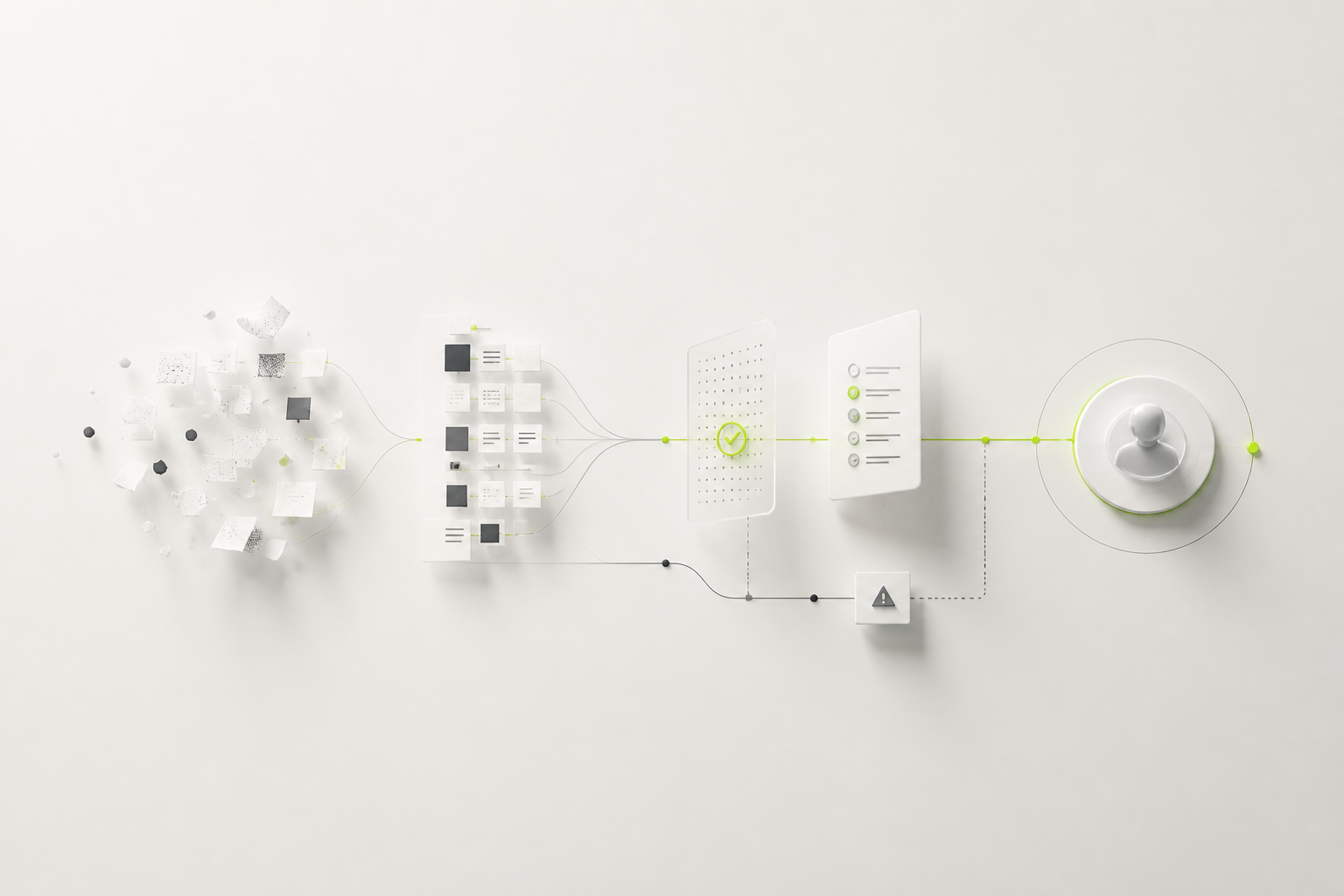
The principle that guides everything we build is one we call expose, don't decide. When the system encounters a discrepancy — say, an address in the CRM that does not match the one on a certificate — it does not silently choose which one is correct. It surfaces the conflict and asks which value to consolidate. It never writes silently to systems of record.
It requests confirmation on sensitive steps, and it does so in a graduated way: low-risk data flows through, while data that formally commits the professional requires explicit sign-off, item by item.
This may look like a technical detail. In reality it is the operational translation of augmented intelligence: precision, transparency, and human control are not features bolted on at the end, but the starting point. And it is precisely this that leads professionals to use the tool on real cases — the ones that matter — and not only in demos, where everything always runs smoothly.
Why write about it, rather than simply build
Because we believe the hardest part of AI adoption is not technological but cultural. Technology, by now, runs on its own. What is missing is a shared vocabulary for talking about it honestly: to distinguish what genuinely changes the work from what is merely a more elegant interface laid over the same old catalog; to recognize when AI becomes a competitive advantage and when it remains just another gadget added to the homepage so a company can say "we have it too."
We want to contribute to that vocabulary. We will do so by describing concrete cases, explaining how the agents we build actually reason, and being candid about where things are difficult and where the limits are real.
We will not sell miracles, for the simple reason that we do not believe in them. We believe in something less spectacular and far more useful: tools that clear away repetitive work in order to give time back to human judgment.
What to expect
In the coming weeks we will publish pieces that get into the substance. How AI is changing feasibility analysis in lending, turning pre-approval from an obstacle course into a conversation. How, in real estate, the value lies not in a prettier search but in closing the bottleneck that comes after the search. And, more broadly, how to design a system that is both powerful and reliable at once — because our conviction is that, without the second, the first is worth nothing.
The future belongs to organizations that put artificial intelligence at the service of people.
If you work in a field where mistakes are costly and trust matters, this blog is written for you.